Class 6 · Ganita Prakash · Chapter 5

Prime Time

CBSE Class 6 Maths practice questions with answers

347 checked questions on this chapter of Ganita Prakash, the NCERT Maths book. Every question has a worked explanation, and teachers can set them as an online test that Clay marks.

347questions
79with pictures
3question types: multiple choice, fill in the blank, true or false
100%with a worked explanation

Prime Time worksheet with answers

Page 1 of the worksheet

Free PDF · 5 questions · answers on the last page

Print it for practice at home or in class. These questions are not used in Clay's online tests.

Download the free PDF

Need the book? Ganita Prakash for Class 6 is free from NCERT, on ncert.nic.in and the ePathshala app.

Try a question from this chapter

Tap an answer. A wrong answer gets a hint, not the solution.

Medium

The chart shows the Sieve of Eratosthenes, used to find prime numbers, with 1 crossed out and 2 circled. Now every multiple of 2 greater than 2 is crossed out. How many numbers are crossed out in this step?
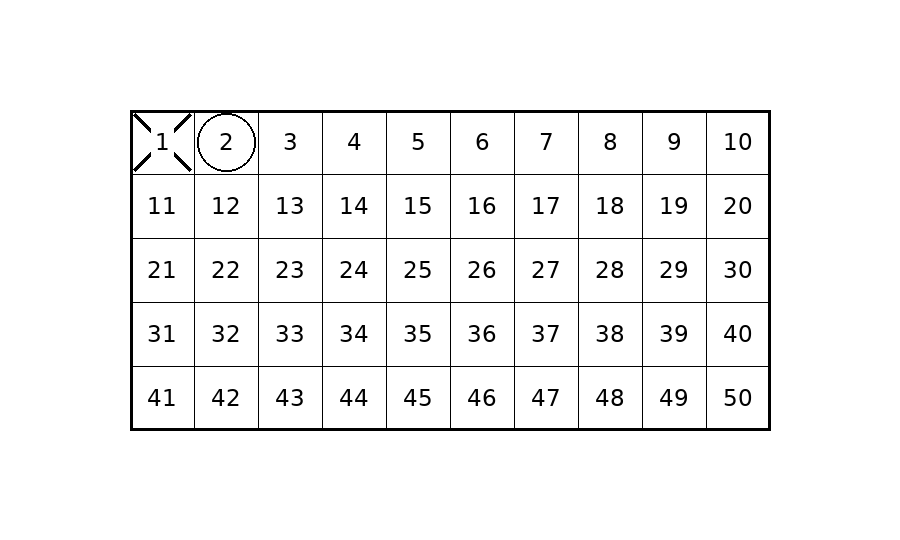
The picture for this question.
Show the answer and explanation

Answer: 24

The multiples of 2 greater than 2 are 4, 6, 8, …, 50, that is 2 × 2 up to 2 × 25. That is 25 − 1 = 24 numbers. The number 2 itself stays circled, because a prime is never crossed out along with its own multiples.

What does Prime Time teach in Class 6?

What mistakes do children make in Prime Time?

The wrong answers in Clay's questions are built around these, so a class report shows which ones each child made.

An odd number called prime without trying any array

Treats oddness as the test for being prime and answers without attempting a second array, so 9, 15, 21 and 25 are all called prime.

Divisibility by 8 tested on the last two digits

Uses the test for 4 one step up: checks whether the last two digits make a multiple of 8, so 8560 (60) is judged "not divisible by 8" and 1116 (16) "divisible".

A prime factorisation stopped at a composite factor

Splits the number once or twice and stops while a composite is still in the product, so 84 is written 2 × 3 × 14 or 4 × 3 × 7.

Divisibility by 4 read off the last digit

Carries the last-digit rule for 2, 5 and 10 over to 4, so a number ending in 4 or 8 (or 0) is taken as a multiple of 4 and one ending in 2 or 6 is not: 1734 "is", 1732 "is not".

How do I set a Prime Time test for my class?

Pick from 347 questions or let Clay choose a mix. Children answer on the family phone, Clay marks every answer, and you see who needs help and with what.

More Class 6 Maths chapters

Chapter 1 Patterns in Mathematics 241 questions · 48 with pictures Chapter 2 Lines and Angles 245 questions · 103 with pictures Chapter 3 Number Play 282 questions · 73 with pictures Chapter 4 Data Handling and Presentation 293 questions · 218 with pictures Chapter 6 Perimeter and Area 456 questions · 206 with pictures Chapter 7 Fractions 668 questions · 161 with pictures Chapter 8 Playing with Constructions 311 questions · 190 with pictures Chapter 9 Symmetry 309 questions · 222 with pictures Chapter 10 The Other Side of Zero 617 questions · 166 with pictures

Talk to us

Email, WhatsApp or call, whichever suits you.

Email

info@claylearn.in

Phone and WhatsApp

+91 90160 57597