Class 6 · Ganita Prakash · Chapter 1

Patterns in Mathematics

CBSE Class 6 Maths practice questions with answers

241 checked questions on this chapter of Ganita Prakash, the NCERT Maths book. Every question has a worked explanation, and teachers can set them as an online test that Clay marks.

241questions
48with pictures
3question types: multiple choice, fill in the blank, true or false
100%with a worked explanation

Patterns in Mathematics worksheet with answers

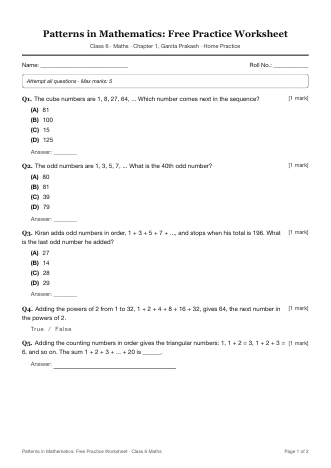
Page 1 of the worksheet

Free PDF · 5 questions · answers on the last page

Print it for practice at home or in class. These questions are not used in Clay's online tests.

Download the free PDF

Need the book? Ganita Prakash for Class 6 is free from NCERT, on ncert.nic.in and the ePathshala app.

Try a question from this chapter

Tap an answer. A wrong answer gets a hint, not the solution.

Medium

Small boxes are stacked to make a cube, as shown in the picture. All the boxes are then taken apart and laid flat to make a square, with the same number of boxes in each row as in each column. How many boxes are in each row of the square?
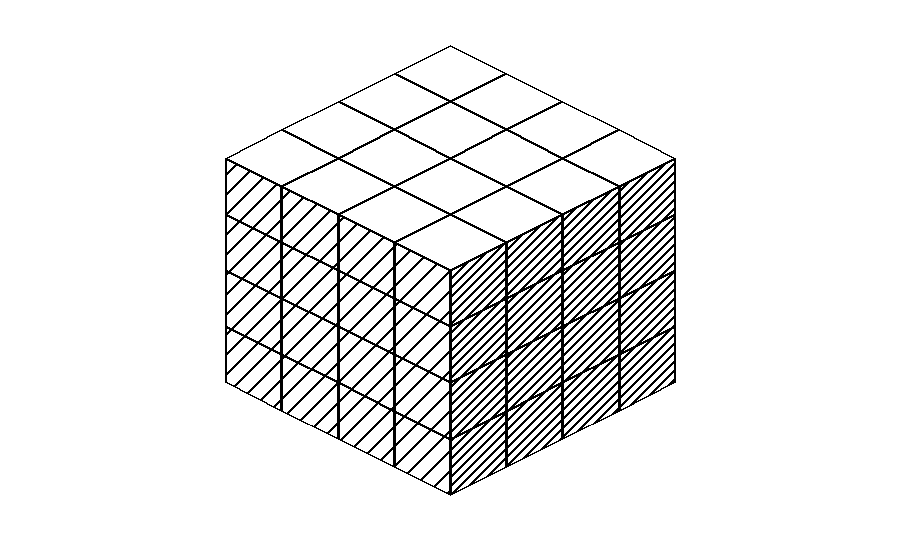
The picture for this question.
Show the answer and explanation

Answer: 8

The cube has 4 boxes along each edge, so it holds 4 × 4 × 4 = 64 boxes. The same 64 boxes make a square with 8 in each row, because 8 × 8 = 64. The number 64 is both a cube number and a square number. 4 is the edge of the cube, 16 is one layer, and 32 is half of the boxes.

What does Patterns in Mathematics teach in Class 6?

What mistakes do children make in Patterns in Mathematics?

The wrong answers in Clay's questions are built around these, so a class report shows which ones each child made.

Position answered as the value, or a dot picture read by its rows

Asked for the 5th square number gives 5, asked how many dots a 4-row triangle holds gives 4.

Sequence started one term late

Begins powers of 2 at 2, triangular numbers at 3, cubes at 8 or hexagonal numbers at 7, dropping the 1 the book puts first, so every position she names is one too high (the "5th power of 2" comes out 32).

Powers confused with the times table

Continues 1, 2, 4 with 6 (adding 2), accepts 6, 10, 12 as powers of 2 because they are even, or accepts 6, 12, 15 as powers of 3 because they are in the 3-times table; "power of" is read as "multiple of".

Hexagonal numbers as 6 × position + 1, or with the centre dot dropped

Runs 6 × n + 1 (7, 13, 19, 25) instead of 6 × (triangular number) + 1, or runs 6 × triangular without the + 1 (6, 18, 36); the ring structure (a centre dot, then rings of 6, 12, 18) is replaced by a flat step of 6.

How do I set a Patterns in Mathematics test for my class?

Pick from 241 questions or let Clay choose a mix. Children answer on the family phone, Clay marks every answer, and you see who needs help and with what.

More Class 6 Maths chapters

Chapter 2 Lines and Angles 245 questions · 103 with pictures Chapter 3 Number Play 282 questions · 73 with pictures Chapter 4 Data Handling and Presentation 293 questions · 218 with pictures Chapter 5 Prime Time 347 questions · 79 with pictures Chapter 6 Perimeter and Area 456 questions · 206 with pictures Chapter 7 Fractions 668 questions · 161 with pictures Chapter 8 Playing with Constructions 311 questions · 190 with pictures Chapter 9 Symmetry 309 questions · 222 with pictures Chapter 10 The Other Side of Zero 617 questions · 166 with pictures

Talk to us

Email, WhatsApp or call, whichever suits you.

Email

info@claylearn.in

Phone and WhatsApp

+91 90160 57597