Class 5 · Maths Mela · Chapter 13

Animal Jumps

CBSE Class 5 Maths practice questions with answers

247 checked questions on this chapter of Maths Mela, the NCERT Maths book. Every question has a worked explanation, and teachers can set them as an online test that Clay marks.

247questions
70with pictures
3question types: multiple choice, fill in the blank, true or false
100%with a worked explanation

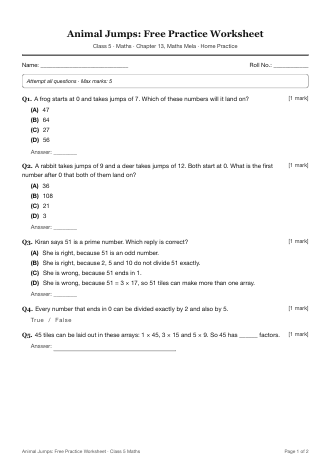
Animal Jumps worksheet with answers

Page 1 of the worksheet

Free PDF · 5 questions · answers on the last page

Print it for practice at home or in class. These questions are not used in Clay's online tests.

Download the free PDF

Need the book? Maths Mela for Class 5 is free from NCERT, on ncert.nic.in and the ePathshala app.

Try a question from this chapter

Tap an answer. A wrong answer gets a hint, not the solution.

Medium

Vijayendra made the array shown. He wants to arrange all of its squares in equal rows, with none left over. Which number of rows can he NOT use?
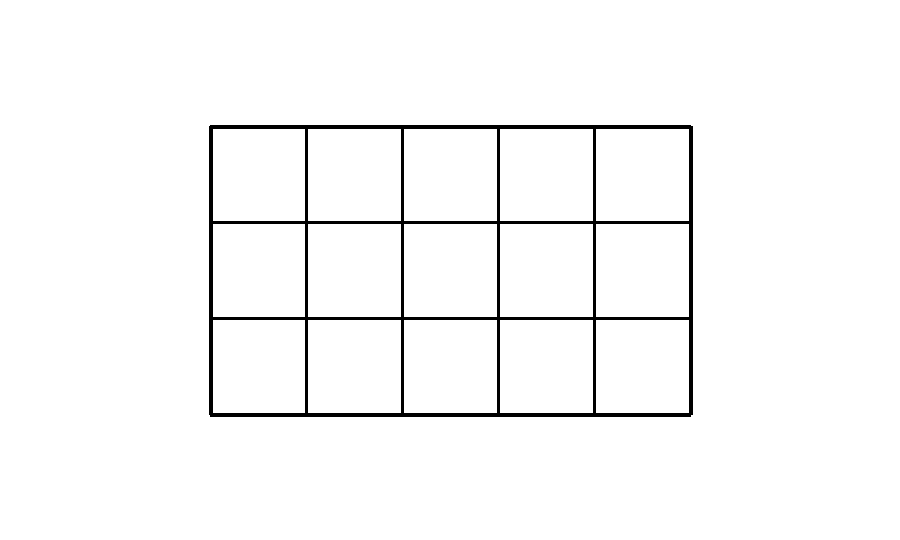
The picture for this question.
Show the answer and explanation

Answer: 2 rows

The array has 3 × 5 = 15 squares. 1 row of 15, 3 rows of 5 and 5 rows of 3 all use 15 squares. 2 rows would need 15 squares shared equally between 2 rows, and 2 × 7 = 14 and 2 × 8 = 16, so 2 is not a factor of 15.

What does Animal Jumps teach in Class 5?

What mistakes do children make in Animal Jumps?

The wrong answers in Clay's questions are built around these, so a class report shows which ones each child made.

A near-miss factor pair accepted as a rectangular arrangement

Offering ways to arrange a given number of objects in equal rows and columns, gives a pair whose product is close to the number rather than equal to it, so 24 cupcakes are said to fit in 5 rows of 5 or 7 rows of 3.

A common multiple built by combining the two step sizes

Finds a number both animals land on by adding the two jump sizes, or by writing the two digits side by side, so the common multiples of 3 and 4 are given as 7 or as 34 instead of 12, 24, 36.

The product taken as the first common multiple

Multiplies the two jump sizes together and offers the product as the first number both animals reach, so for jumps of 4 and 6 she gives 24 instead of 12.

A number skipped over accepted as a multiple

Judges that a jump size lands on a number because the number is close to one it does land on, or simply because it lies inside the range being counted, so the frog jumping 3s is said to touch 67 and the kangaroo jumping 8s is said to touch 50.

How do I set an Animal Jumps test for my class?

Pick from 247 questions or let Clay choose a mix. Children answer on the family phone, Clay marks every answer, and you see who needs help and with what.

More Class 5 Maths chapters

Chapter 1 We the Travellers—I 300 questions · 77 with pictures Chapter 2 Fractions 352 questions · 98 with pictures Chapter 3 Angles as Turns 239 questions · 99 with pictures Chapter 4 We the Travellers—II 29 questions Chapter 5 Far and Near 37 questions Chapter 6 The Dairy Farm 412 questions · 108 with pictures Chapter 8 Weight and Capacity 397 questions · 129 with pictures Chapter 9 Coconut Farm 343 questions · 43 with pictures Chapter 10 Symmetrical Designs 186 questions · 94 with pictures Chapter 11 Grandmother’s Quilt 224 questions · 92 with pictures Chapter 12 Racing Seconds 247 questions · 94 with pictures Chapter 14 Maps and Locations 237 questions · 201 with pictures Chapter 15 Data Through Pictures 254 questions · 216 with pictures

Talk to us

Email, WhatsApp or call, whichever suits you.

Email

info@claylearn.in

Phone and WhatsApp

+91 90160 57597